Why Does Aneuploidy In Animals Generally Result In Phenotypic Abnormalities?. Frequency increases with maternal age. The most common type of chromosomal abnormality is known as aneuploidy, an abnormal chromosome number due to an extra or missing chromosome.most people with aneuploidy have trisomy (three copies of a chromosome) instead of monosomy (single copy of a chromosome).
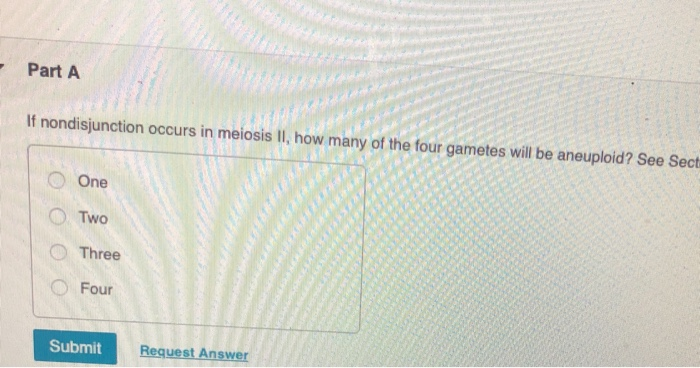
Solved Part A If Nondisjunction Occurs In Meiosis II, How from www.chegg.com
6 why is a triploid organism usually sterile? Why does aneuploidy in animals generally result in phenotypic abnormalities?. Leave a reply cancel reply.
Get The Answers You Need, Now!
When an individual is missing one of the chromosomes from a pair, the condition is called mon. Leave a reply cancel reply. Synthesis of extra chromosomes creates a metabolic burden that decreases cell viability.
Which Of The Following Consequences Is A Common Outcome Of A Viable Trisomy?
Why is aneuploidy in animals generally detrimental? Why does aneuploidy in animals generally result in phenotypic abnormalities? Aneuploidy occurs when an individual is missing or has an additional chromosome.
B) It Results In Chromosome Segregation Errors In Mitosis Because Of Aberrant Chromosome Numbers.
Why is aneuploidy in animals generally detrimental? Managing editors of us news organizations b. It is composed of one type of molecule.
In Animals, Including Humans, The Individual Is Always Diploid, And Meiosis.
Frequency increases with maternal age. See section 10.2 (page 367). It results in an imbalance of gene products from affected chromosomes, which alters normal development.
Most People With This Show No Abnormalities, But It Can Result
There are many types of chromosome abnormalities. It results in dna replication errors due to the aberrant number of chromosomes. However, they can be organized into two basic groups:
Share
Post a Comment
for "Why Does Aneuploidy In Animals Generally Result In Phenotypic
Abnormalities?"

Post a Comment for "Why Does Aneuploidy In Animals Generally Result In Phenotypic Abnormalities?"